You're the only researcher, you've been told to use AI, and nobody has shown you how
You're covering more studies with the same hours, everyone expects the same rigor, and the AI you've tried hands back something so generic you end up rewriting it and wondering why you didn't just do it yourself.
I help you use AI on your research without losing your craft or your judgment, on your own with my AI bundle, with your whole team in a live training, or through my weekly newsletter.
Or get my free weekly newsletter, read by 10,000 researchers

Synthesis Check from the AI bundle, showing what an AI synthesis got wrong before it went to a stakeholder
Here's what I'm hearing from researchers right now
I talk to researchers every week, on calls, in workshops and via email, and the same things keep coming up. If a few of these sound like you, it doesn't mean you're behind. Every team I work with is confused about AI right now, and researchers feel it first, because so many of us are doing this on our own.
"Use AI" came with no instructions
Leadership wants research faster and AI-powered, and "what are we supposed to be doing?" is the question I get asked most
There's nobody to check your thinking with
Your lead left, or there never was one, so the only sparring partner you have is a chatbot that agrees with everything
Checking AI output is exhausting
It sounds legitimate, and then you find a quote that isn't in the transcript, so you go back and check every single line
Your stakeholders are using AI to go around you
A designer sends over a ChatGPT brief "to save you time", or a PM puts your report into an LLM and decides they don't need to read it
You tried building it yourself and ran out of time
You took the course, started a few skills, and then real studies got in the way before any of it was useful
You're worried about losing touch with your own work
If AI does the tagging and the first draft, you're scared you'll end up reading an AI summary of what the AI wrote, and lose the craft you've worked so hard for
Become the person who connects the dots
Anybody can run a study and produce insights now. What teams are missing is someone who can look across every place customers show up, from interviews and surveys to support tickets, sales calls and app reviews, and tell them what it all means for the decision in front of them.
Pulling those sources together used to take me weeks, if not months. With AI set up around your own way of working, you bring them into one view and trace every claim back to where it came from, so you become the person teams talk to before they ship.
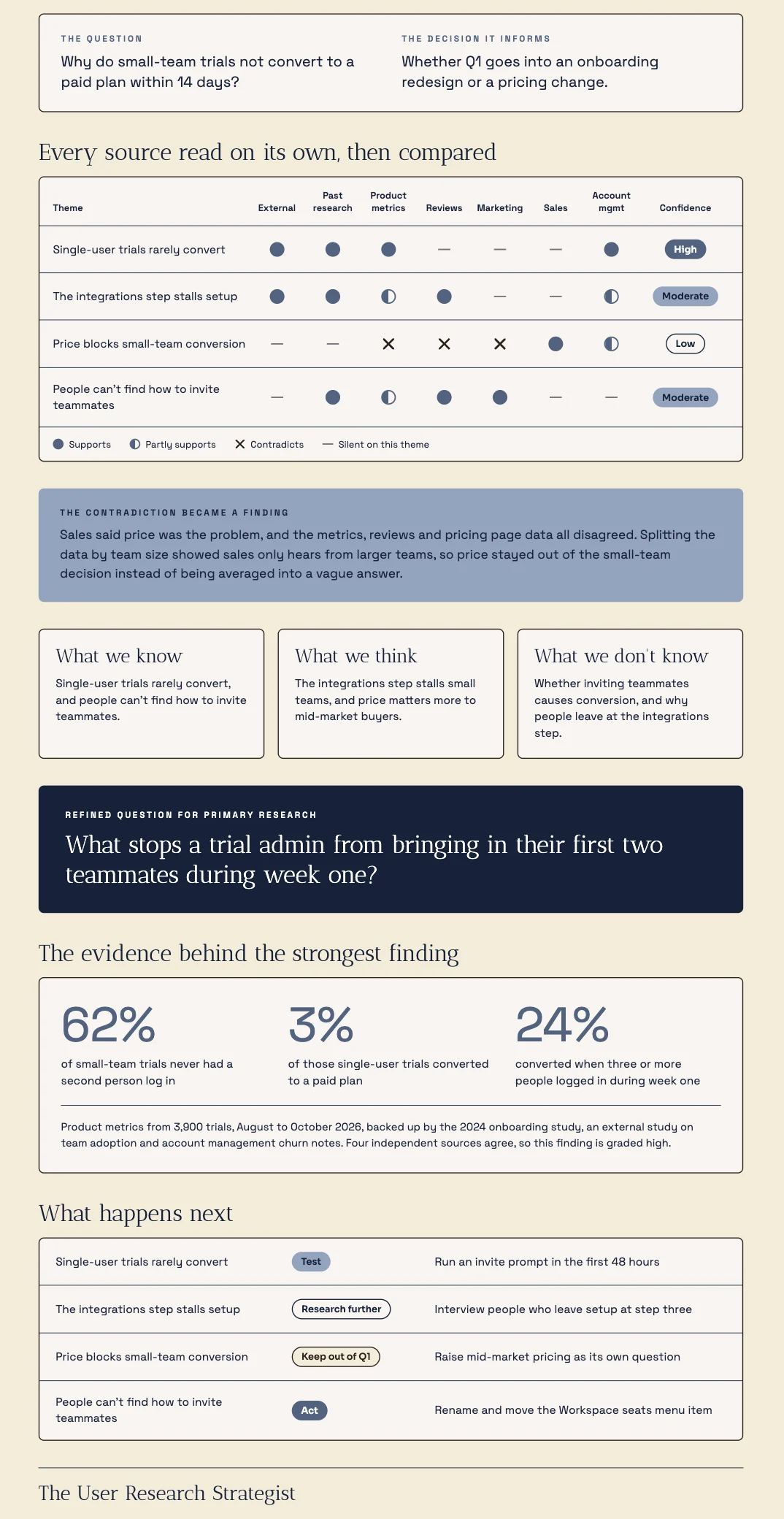
The holistic literature review skill, comparing seven sources theme by theme before any new research starts
See what you already know
Compare past studies, reviews and tickets before you recruit anyone, so you only research what's still unknown.
Trace every claim
The traceability skill links each finding to its sources, so when someone asks "who said that?", you have the answer.
Speak the business's language
Tie what customers say across every touchpoint to the metrics and decisions your leadership already cares about.
How I can help
The UXR AI Bundle
For when you're doing research on your own and want a senior researcher's way of working that you can customize.
- 80+ skills, agents and prompts built from 13 years of real studies
- Sparring skills that push back on your thinking when nobody else is around
- Synthesis Check, so you're not rereading every transcript by hand
- Stakeholder skills with your limits built in
$249 one-time, or $699 for your whole team
See the AI bundleTeam training
For when your whole team needs to work this way, built around your own research.
- Live sessions working from your team's own guides, synthesis and reports
- Everyone leaves with working v1 skills built from their own examples
- The same quality, whoever runs the study
- A dashboard of time saved to show leadership
Priced per session, not per person
See team trainingThe weekly newsletter
One useful thing every week on impact, strategy and using AI without losing your craft.
- Frameworks and examples from my own studies
- Read by 10,000 researchers, team leads and heads of research
- For the people excited about AI and the ones a bit sick of it
Free, once a week
Subscribe freeWhat your research looks like with the AI bundle
You stay in the work the whole way through while the bundle takes the repetitive parts off your plate and pushes back on your thinking. You get to spend your time on the most important part of connecting dots and bringing a strategic, holistic lens to the team
Scoping a request
"Can you research onboarding?" lands in Slack, you start a plan from a blank page, and the decision, the metric and the success criteria only come up once someone asks what the point was.
A sparring skill pushes back on the request first, asking what decision it informs and what number it moves, then the research plan skill drafts it in your template, ready for you to tweak.
Synthesizing
Your 12 interviews are in one place, the survey is somewhere else, and the AI summary you tried came back flat and hollow, with no why and no consequence.
Synthesis skills built from real studies give you a first draft with the key learning, the why and the consequence, which you compare against your own affinity diagram.
Checking before a readout
The night before, you reread every quote, claim and count against the transcripts by hand.
Synthesis Check grades every quote, claim and count against your transcripts and tells you what to fix first.
Working with stakeholders
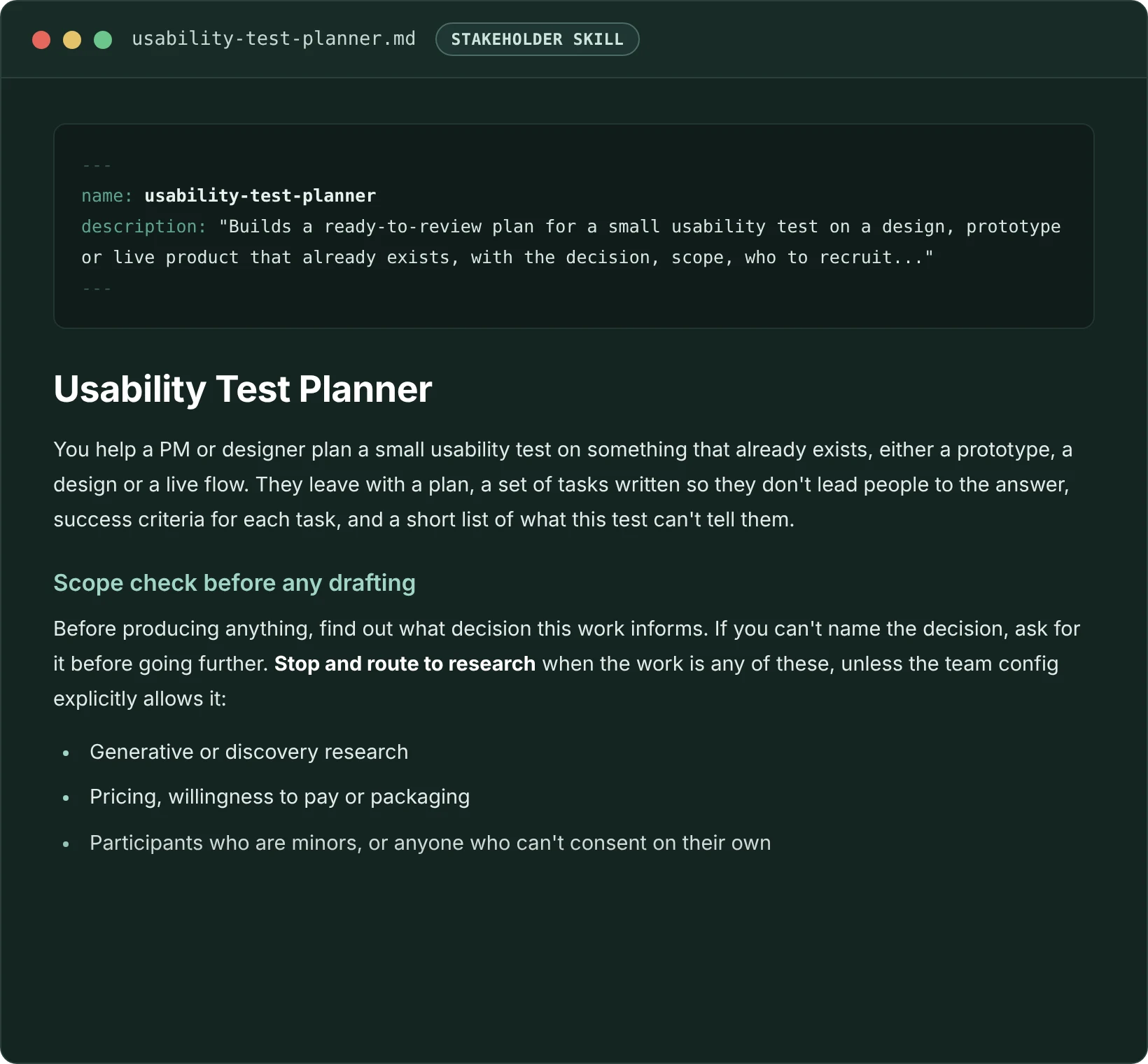
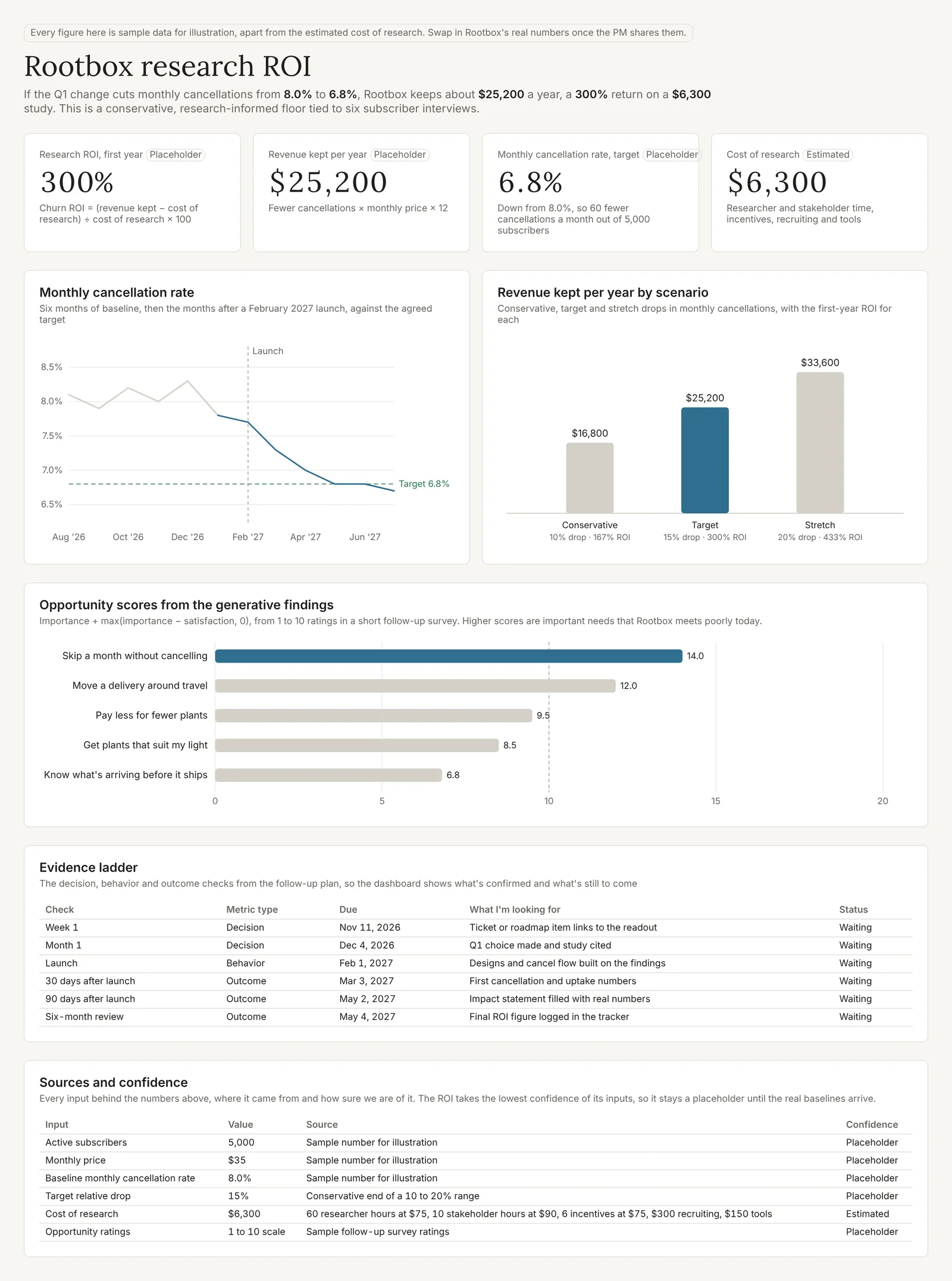
A PM runs a "quick usability test" with whatever a generic AI told them, and you find out when the results are already in a deck.
They use stakeholder skills with your limits built in, anything like pricing or discovery comes straight back to you, and you review the work at set checkpoints.
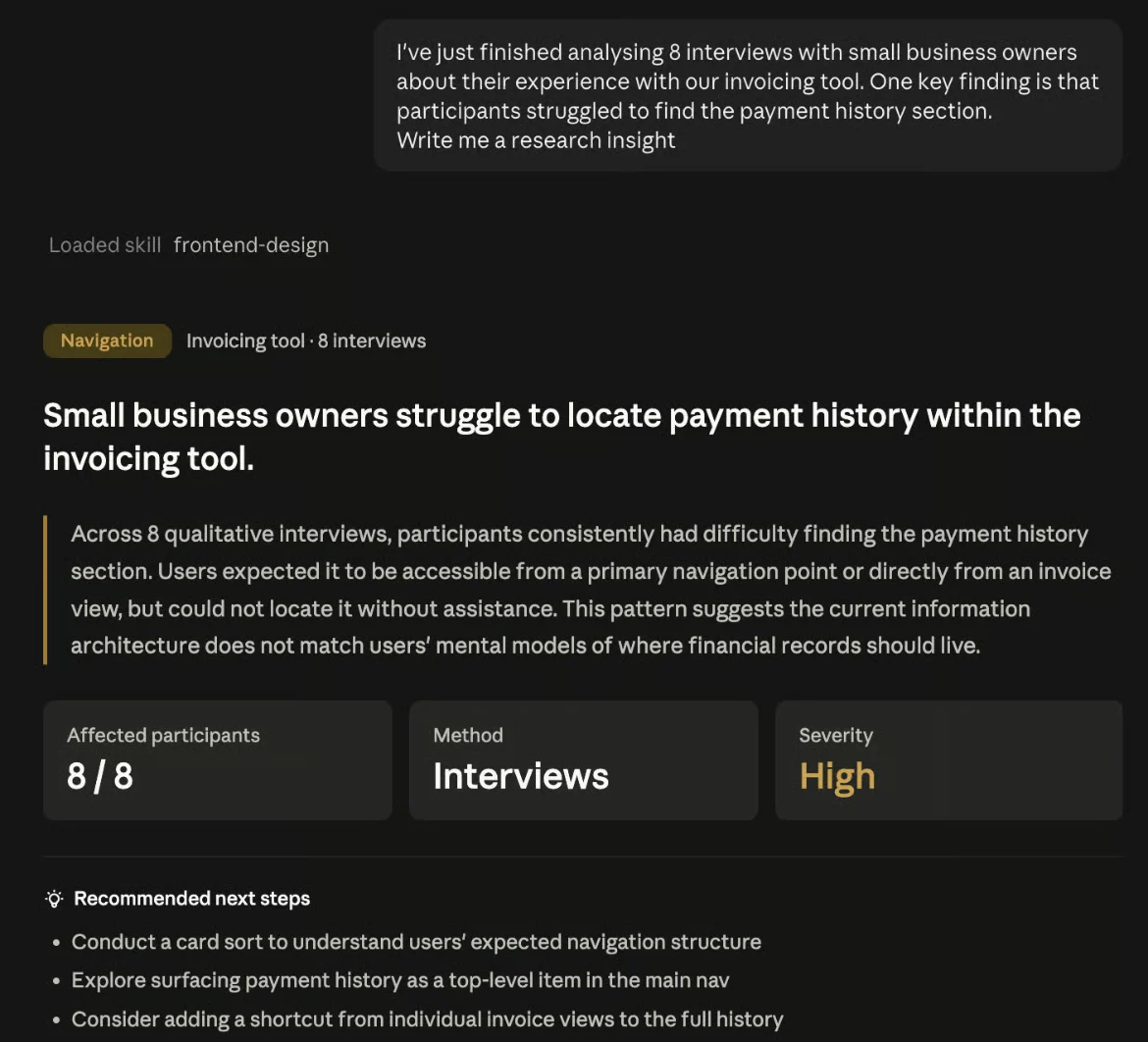
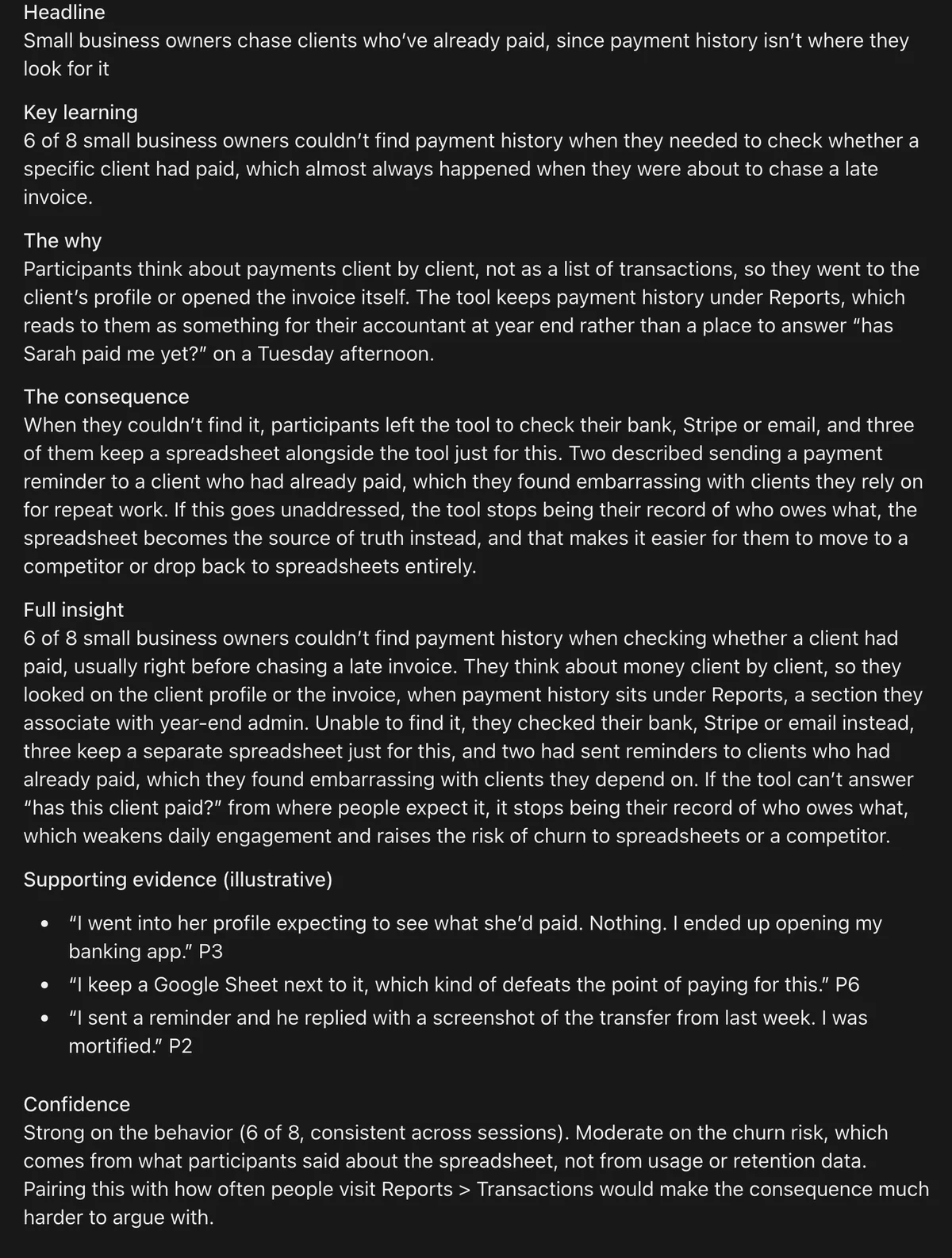
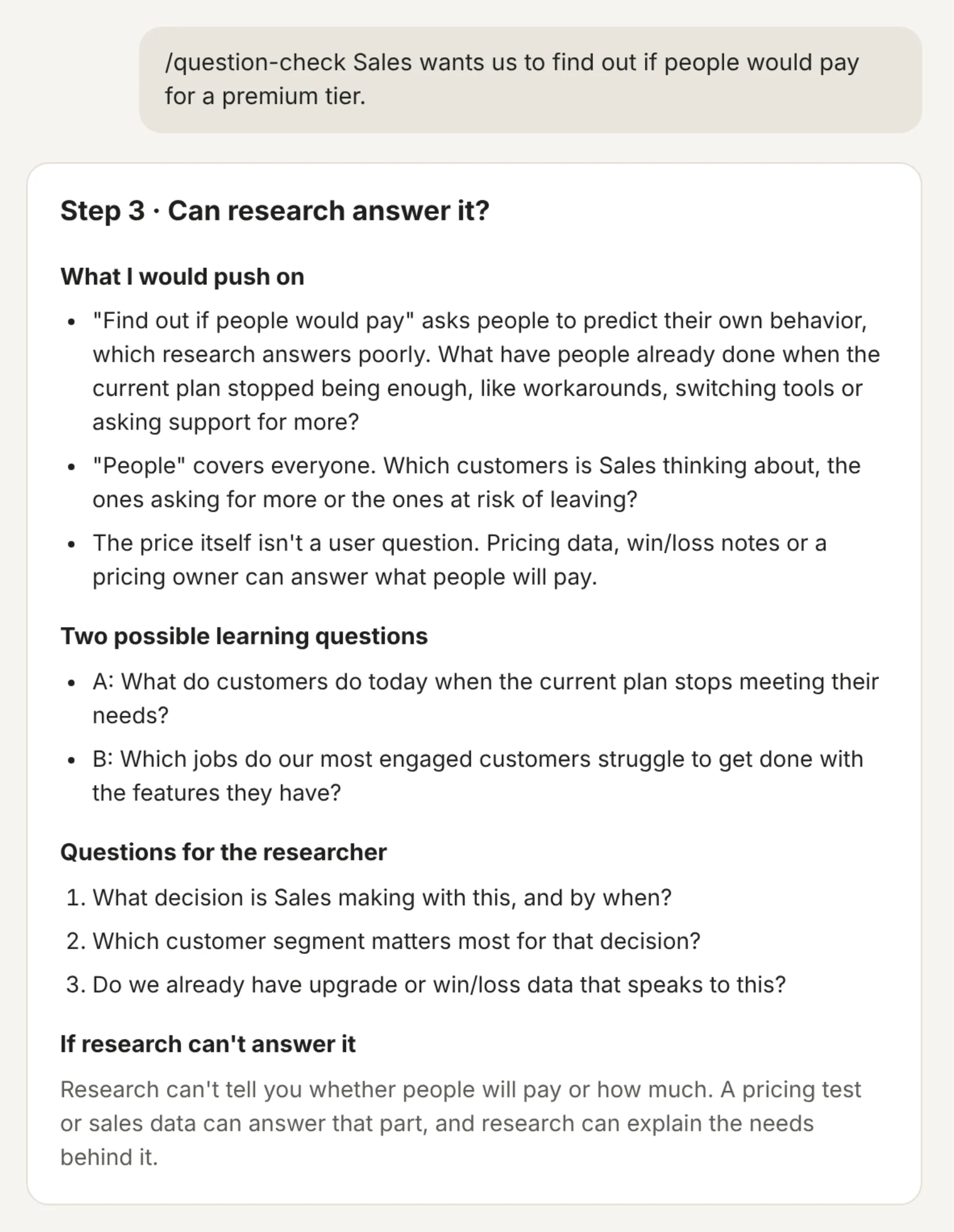
"The sparring agents are amazing. It feels like I'm having a conversation with you and it has helped me immensely with brainstorming and not feeling so alone in my role. Thank you!!"
"I got your AI bundle a month ago and, since then, it's been so incredibly helpful in making sure I stay consistent, always connect my research to impact, and also has allowed me to enable stakeholders to actually write good research plans and screeners! These resources are an absolute gem!"
"I use them in my workflows every single day and they've not only saved me time but also my sanity of the sheer months it would take me to create these on my own."
When your team needs to build it together
A lot of researchers buy the bundle, try it on a few studies, and then their manager asks how the rest of the team can work this way. That's usually when I come in.
Consistency
Everyone prompts differently, and the same question gets two different answers depending on who asked it.
The whole team works from shared skills built from your own guides, synthesis and reports, so the quality is the same whoever runs the study.
Real life after the session
The last training sounded great, and then the team got back to their real studies and didn't know where to start.
Everyone leaves with working v1 skills built from their own examples during the sessions, and knowing how to build the next one.
Stakeholders
PMs and designers run their own research with whatever a generic AI tells them, and the team ends up cleaning it up.
Stakeholder skills carry your team's limits, with checkpoints where a researcher reviews the work before anything goes out.
Proving it to leadership
Researchers are being judged on how they use AI in their performance reviews, with nothing concrete to show.
I build the training around what your team is measured on, and help you set up a dashboard of the time you've saved.
I price per session, not per person, I'm happy to sign an NDA, I delete everything afterwards, and mixed levels work well, because I put beginners and advanced people together in the breakout groups.
Claude Training for Teams
Three hours, live, working from your team's own transcripts and templates, so everyone knows how to use Claude on the research you're already doing.
See the detailsBuild Your Team's Claude Skills Library
Four hours turning the guides, synthesis templates and report structures you already trust into skills the whole team can reuse.
See the detailsClaude for Research Leaders
Two hours for research leads setting the AI plan for their function, with a point of view you can take to your CPO and a rollout plan for your team.
See the details"Nikki immediately understood our context, needs, and goals, and created a workshop customized with hands-on exercises tailored to our company."
"With Nikki's guidance, our team has emerged more confident, more strategic, and better equipped to influence product direction."
"Nikki's mix of strategic depth, hands-on execution, and genuine investment in her clients' success makes her an invaluable partner for high-growth teams."
Want to start smaller? The $699 team license gets everyone on the same skills first.
The questions I get asked most
Does the bundle work if my company uses ChatGPT, Copilot or Gemini?
Yes. The skills are .md files, so you can use them in any LLM your company allows. The plugins are built for Claude Cowork, and I've had buyers turn them into Copilot agents too.
I've bought AI skills before and never used them. Why would this be different?
I hear this a lot. Usually it's that generic skills feel like nobody who does research wrote them. Every skill in here comes from my own studies and has been tested against past projects, so the output looks like something a researcher made. I recommend starting with the one task you do most, like research plans or synthesis.
Will I lose touch with my own research?
I worried about this too, so I use the sparring skills before I use anything that writes for me. You think it through, the skill pushes back, and only then does anything get drafted. I still do my own affinity diagram on every study and compare it with Claude's.
How do I know the AI synthesis is right?
Checking every quote against every transcript by hand is exhausting, which is why I built Synthesis Check. It goes back to your transcripts, catches made-up quotes and quotes credited to the wrong person, and gives you a fix list before you share anything. I run it on my own synthesis too, and after 13 years I still get a fix list.
Should my team get the team license or training?
The $699 team license gets everyone working from my skills. Training is for when you want skills built from your own team's examples, with me working through them with you during the sessions. A lot of teams start with the license and come to me for training once they've used it on a few studies.
What about participant data and privacy?
Check what your company allows first. I take personal information out of transcripts before anything goes into an LLM, and I turn off web search for analysis, so Claude only works from your data. For team training, I'm happy to sign an NDA and I delete everything afterwards.
What if the bundle isn't right for me?
I don't offer refunds on digital products, but email me and we'll work something out.

I did it the manual way
I've spent a lot of my career as the first and only researcher, which is why I build everything for the person doing this alone. I led research at Zalando, taught at Pratt Institute, and I've been doing user research for 13 years and using AI in it for over three.
I wrote Impact, my book on building a research practice that gets used, and I live in Jersey, in the Channel Islands, usually with my cat Smash judging me from the desk.